Risk vs Return in Financial Decisions
The power of compounding means earning returns on both your original investment and the returns it generates over time. The longer you stay invested, the faster your money grows. In India, compounding is key to building wealth through SIPs, mutual funds, and fixed deposits. Starting early and staying consistent matters more than investing a large amount late.
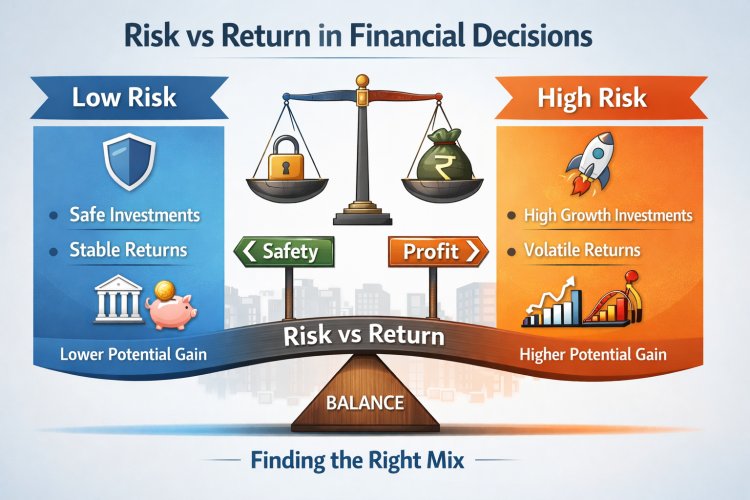
Every financial decision—whether personal or business-related—involves one core concept: Risk vs Return in Financial Decisions. From choosing a fixed deposit to investing in stocks or expanding a business, understanding how risk and return work together is essential for making smart and informed choices.
This topic is especially important for students and professionals pursuing Certified Corporate Accounting, SAP FICO (Finance & Controlling), and Taxation (Income Tax & GST), as risk-return analysis plays a major role in finance, accounting, and investment planning.
What Is Risk? (Risk Explained)
Risk refers to the possibility that the actual outcome of a financial decision may differ from the expected outcome, often resulting in loss or lower-than-expected returns.
Risk Explained in Simple Words
Risk means uncertainty. When you invest or make a financial decision, there is no guarantee that you will earn the expected profit.
Common Types of Financial Risk
-
Market Risk – Loss due to market fluctuations
-
Credit Risk – Risk of non-payment by customers or borrowers
-
Liquidity Risk – Difficulty in converting assets into cash
-
Operational Risk – Loss due to internal failures or errors
-
Inflation Risk – Purchasing power decreases over time
In SAP FICO (Finance & Controlling), identifying and managing these risks is crucial for business planning and control.
What Is Return? (Return Explained)
Return is the gain or income earned from an investment over a period of time. It can be in the form of profit, interest, dividends, or capital appreciation.
Return Explained in Simple Words
Return is what you get back from an investment.
Types of Returns
-
Interest income (FDs, bonds)
-
Dividend income (shares, mutual funds)
-
Capital gains (increase in asset value)
-
Business profits
In Taxation (Income Tax & GST), returns are taxable depending on their nature, making it important to understand how income is generated.
The Risk-Return Relationship
The Risk-Return Relationship states that higher risk is associated with higher potential returns, while lower risk usually results in lower returns.
Understanding the Risk-Return Relationship
-
Low risk → Low return (Savings accounts, fixed deposits)
-
Moderate risk → Moderate return (Balanced mutual funds)
-
High risk → High return (Equity shares, startups)
This principle is the foundation of Risk vs Return in Financial Decisions and is widely applied in investment planning and corporate finance.
Risk vs Return in Financial Decisions: A Simple Comparison
| Factor | Risk | Return |
|---|---|---|
| Meaning | Possibility of loss | Gain from investment |
| Nature | Uncertain | Expected |
| Measurement | Volatility, probability | Profit, interest, growth |
| Relationship | Increases uncertainty | Rewards risk-taking |
Understanding this balance helps individuals and businesses avoid emotional and impulsive decisions.
Risk vs Return in Personal Financial Decisions
In personal finance, individuals constantly evaluate risk and return while:
-
Choosing investment options
-
Planning retirement
-
Saving for goals like education or buying a house
Examples:
-
Fixed deposits offer low risk and stable returns.
-
Equity mutual funds involve higher risk but offer higher long-term returns.
-
Real estate carries moderate risk with potential appreciation.
Proper assessment ensures financial stability and long-term wealth creation.
Risk vs Return in Business & Corporate Finance
In business, Risk vs Return in Financial Decisions plays a role in:
-
Capital budgeting
-
Project evaluation
-
Business expansion
-
Credit decisions
Corporate Example:
A company investing in new technology faces higher risk but may gain competitive advantage and higher profits.
Professionals trained in Certified Corporate Accounting and SAP FICO (Finance & Controlling) use financial models to measure risk and estimate expected returns before taking decisions.
Role of Risk vs Return in Investment Planning
Investment planning is incomplete without understanding risk and return.
Key Considerations:
-
Risk appetite of the investor
-
Investment horizon
-
Financial goals
-
Tax implications
In Taxation (Income Tax & GST), after-tax return matters more than gross return, making tax planning an important part of financial decision-making.
Managing Risk Without Sacrificing Return
Risk cannot be eliminated, but it can be managed.
Common Risk Management Techniques:
-
Diversification of investments
-
Asset allocation
-
Regular portfolio review
-
Hedging strategies
-
Insurance coverage
These techniques help maintain a healthy balance between risk and return.
Importance of Risk vs Return Knowledge for Finance Students
Understanding Risk vs Return in Financial Decisions is essential for:
-
Accounting students
-
Finance professionals
-
Business owners
-
Investment advisors
Courses like Certified Corporate Accounting, SAP FICO (Finance & Controlling), and Taxation (Income Tax & GST) emphasize this concept because it directly impacts profitability, compliance, and financial stability.
Practical Examples of Risk vs Return
-
Savings Account – Very low risk, very low return
-
Fixed Deposit – Low risk, predictable return
-
Mutual Funds – Moderate risk, moderate return
-
Equity Shares – High risk, high return
-
Startup Investment – Very high risk, very high potential return
Choosing the right option depends on individual goals and risk tolerance.
Conclusion
Risk vs Return in Financial Decisions is a fundamental concept that affects every investment and business choice. Risk represents uncertainty, while return represents reward. A strong understanding of the Risk-Return Relationship helps individuals and businesses make smarter, more balanced financial decisions. If you are learning finance through Certified Corporate Accounting, working with SAP FICO (Finance & Controlling), or managing Taxation (Income Tax & GST), mastering this concept will strengthen your financial judgment and long-term success.
What's Your Reaction?