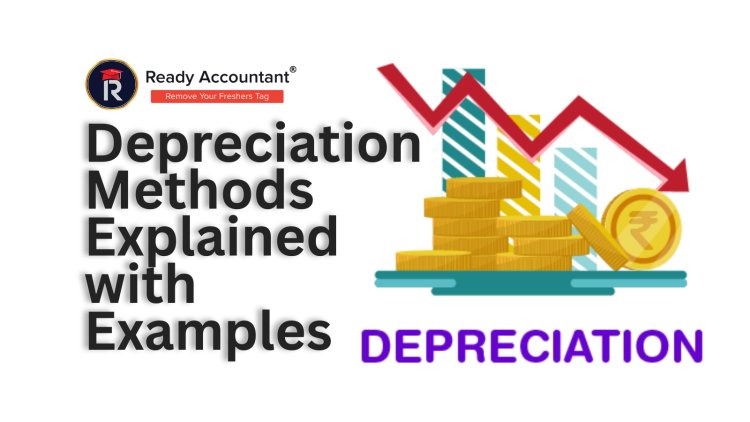
Depreciation Methods Explained with Examples
Depreciation is the gradual decline in an asset’s value due to use or aging. It helps businesses calculate real profits, meet Taxation (Income Tax & GST) requirements, and maintain accurate financial statements. Key methods include: SLM: Equal depreciation every year WDV: Higher depreciation in early years Units of Production: Based on actual usage SYD: Accelerated depreciation These methods are widely used in corporate accounting, financial reporting, and tools like SAP FICO, making them essential for students and professionals in Certified Corporate Accounting and finance roles.
Depreciation is one of the most important concepts in accounting, finance, taxation, and corporate reporting. Whether you are a student pursuing Certified Corporate Accounting, working with tools like SAP FICO (Finance & Controlling), or dealing with Taxation (Income Tax & GST), understanding depreciation is essential for accurate financial planning and compliance.
In this comprehensive guide, we will break down Depreciation Methods Explained with Examples, helping you understand how each method works, when it is used, and how it impacts financial statements.
???? What Is Depreciation?
Depreciation is the gradual reduction in the value of a tangible fixed asset due to wear and tear, usage, or obsolescence. Businesses purchase machinery, vehicles, computers, furniture, and other long-term assets to run operations. Over time, these assets lose value, and this decrease must be recorded systematically.
Depreciation helps in:
-
Showing the true value of assets
-
Accurately calculating profit
-
Complying with taxation laws like Income Tax
-
Ensuring proper financial reporting under corporate accounting standards
???? Why Depreciation Matters
Depreciation affects both profitability and tax liability. For example, under Taxation (Income Tax & GST) rules, companies can claim depreciation as an expense, reducing taxable income. Similarly, software like SAP FICO (Finance & Controlling) uses different depreciation keys to automatically calculate depreciation based on company policy.
1️⃣ Straight-Line Method (SLM)
The Straight-Line Method is the simplest and most commonly used depreciation method. Here, the asset loses value evenly every year.
Formula:
Example:
-
Cost of machine = ₹5,00,000
-
Residual value = ₹50,000
-
Useful life = 5 years
The company will charge ₹90,000 every year for 5 years.
Where Used:
-
Corporate offices
-
Computers
-
Furniture
-
Assets with predictable usage
SLM is commonly applied in corporate reporting and in Certified Corporate Accounting courses.
2️⃣ Written Down Value Method (WDV)
(Also known as Declining Balance Method)
Under the WDV method, a fixed percentage is applied to the book value of the asset each year. The depreciation amount decreases every year.
Formula:
Example:
-
Asset cost = ₹3,00,000
-
Rate = 20%
| Year | Opening Value | Depreciation | Closing Value |
|---|---|---|---|
| 1 | 3,00,000 | 60,000 | 2,40,000 |
| 2 | 2,40,000 | 48,000 | 1,92,000 |
| 3 | 1,92,000 | 38,400 | 1,53,600 |
Where Used:
-
Indian Income Tax Act prefers WDV
-
Machinery and equipment
-
Assets with higher initial wear and tear
This method is widely applied in Taxation (Income Tax & GST) calculations.
3️⃣ Units of Production Method
This method calculates depreciation based on actual usage, making it ideal for manufacturing businesses.
Formula:
Example:
-
Machine cost = ₹4,00,000
-
Residual value = ₹40,000
-
Total capacity = 2,00,000 units
-
Units produced in Year 1 = 50,000
Where Used:
-
Production-based machines
-
Mining equipment
-
Manufacturing units
In systems like SAP FICO (Finance & Controlling), this method is used to ensure realistic asset consumption.
4️⃣ Sum-of-the-Years-Digits (SYD) Method
SYD accelerates depreciation—higher in early years and lower later.
Formula Components:
Where n = useful life of asset
Example:
-
Cost = ₹2,50,000
-
Residual value = ₹25,000
-
Useful life = 5 years
SYD = 5(6)/2 = 15
Depreciable amount = ₹2,25,000
| Year | Remaining Life | Depreciation |
|---|---|---|
| 1 | 5 | 75,000 |
| 2 | 4 | 60,000 |
| 3 | 3 | 45,000 |
| 4 | 2 | 30,000 |
| 5 | 1 | 15,000 |
Where Used:
-
Assets losing value quickly
-
Tech equipment
-
Vehicles
5️⃣ Depreciation as per Companies Act & Income Tax Act
In India, depreciation differs under:
-
Companies Act, 2013 → Uses SLM or WDV
-
Income Tax Act, 1961 → Prefers WDV for most assets
For those working in Taxation (Income Tax & GST) or performing statutory audits, understanding both approaches is crucial.
How Depreciation Appears in Financial Statements
Profit & Loss Account
Depreciation is shown as an expense, reducing net profit.
Balance Sheet
-
Asset value reduces every year (Net Block)
-
Depreciation reduces the carrying amount of assets
In software like SAP FICO, depreciation automatically updates both balance sheet and profit & loss accounts using integrated modules.
Choosing the Right Depreciation Method
The choice depends on:
✔ Nature of the asset
✔ Pattern of consumption
✔ Legal requirements
✔ Tax benefits
✔ Company policy
Businesses often use:
-
SLM → For corporate reporting
-
WDV → For tax purposes
-
Units method → For production machinery
Conclusion
Understanding depreciation is essential for accounting professionals, tax consultants, and corporate finance teams. This guide on Depreciation Methods Explained with Examples covers the most widely used methods, their formulas, practical scenarios, and real accounting applications.
Whether you're studying Certified Corporate Accounting, learning advanced modules like SAP FICO (Finance & Controlling), or working in Taxation (Income Tax & GST), mastering depreciation ensures accurate financial reporting, compliance, and better decision-making for businesses.
What's Your Reaction?