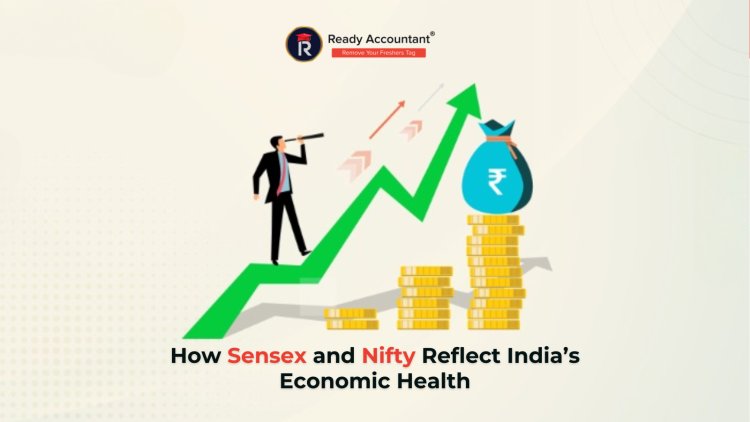
How Sensex and Nifty Reflect India’s Economic Health
Sensex and Nifty act as key indicators of India’s economic health by reflecting corporate performance, investor sentiment, government policies, and global market trends. Rising indices usually signal economic growth, strong business earnings, and increased investment confidence, while declines may indicate economic stress or uncertainty. Understanding how Sensex and Nifty work is essential for investors and finance professionals, especially those pursuing Certified Corporate Accounting, SAP FICO (Finance & Controlling), and Taxation (Income Tax & GST), as it helps in analyzing market trends and making informed financial decisions.
The Indian stock market is often described as the mirror of the economy—and at the center of this reflection stand two powerful indices: Sensex and Nifty. For investors, policymakers, students, and finance professionals alike, understanding How Sensex and Nifty Reflect India’s Economic Health is essential to decoding market movements and economic trends.
Sensex and Nifty do more than show stock price fluctuations. They capture investor sentiment, corporate performance, policy impact, and overall economic momentum. This article explores how these indices function as economic indicators and why they matter in today’s dynamic financial environment.
Understanding Sensex and Nifty: India’s Market Barometers
The BSE Sensex tracks 30 of the largest and most financially sound companies listed on the Bombay Stock Exchange, while the NSE Nifty 50 represents 50 top companies across diverse sectors on the National Stock Exchange. These companies are leaders in banking, IT, FMCG, energy, infrastructure, and manufacturing—sectors that collectively shape India’s economy.
Because these indices include industry giants, any significant rise or fall reflects changes in business performance, consumer demand, and investor confidence. This is why analysts closely watch Sensex and Nifty movements to assess economic health.
Sensex and Nifty as Indicators of Economic Growth
One of the clearest ways Sensex and Nifty reflect India’s economic health is through their long-term trends. When the economy grows, corporate earnings improve, employment rises, and consumption increases. These positive developments push stock prices upward, leading to sustained market rallies.
For example, periods of strong GDP growth, industrial expansion, and rising exports are often accompanied by bullish movements in Sensex and Nifty. On the other hand, economic slowdowns, inflationary pressure, or global crises usually result in market corrections.
Thus, stock market trends often act as a forward-looking indicator, signaling economic expansion or contraction before official data is released.
Corporate Performance and Profitability
Sensex and Nifty are heavily influenced by the financial performance of listed companies. When businesses report higher revenues, better margins, and efficient cost management, investor confidence increases.
Professionals trained in Certified Corporate Accounting play a crucial role here. Accurate financial reporting, compliance, and analysis help companies maintain transparency, which directly affects stock valuations. Strong balance sheets and healthy cash flows send positive signals to the market, pushing indices upward.
In contrast, declining profits, rising debt, or governance issues can drag down both Sensex and Nifty, signaling underlying economic stress.
Impact of Government Policies and Reforms
Economic policies significantly influence market indices. Decisions related to taxation, infrastructure spending, interest rates, and regulatory reforms are quickly reflected in Sensex and Nifty movements.
Reforms in Taxation (Income Tax & GST) are a strong example. Simplified GST structures, corporate tax cuts, or incentives for manufacturing often boost corporate profitability, encouraging investments and driving markets higher. Conversely, uncertainty around tax laws or compliance burdens can make markets volatile.
This direct relationship makes Sensex and Nifty reliable indicators of how well economic policies are being received by businesses and investors.
Role of Banking, Interest Rates, and Inflation
The banking and financial sector carries heavy weight in both Sensex and Nifty. Interest rate decisions by the Reserve Bank of India (RBI) significantly influence these indices.
-
Lower interest rates encourage borrowing and investment, boosting economic activity and stock prices.
-
Higher interest rates control inflation but can slow growth, often leading to cautious market sentiment.
Finance professionals skilled in SAP FICO (Finance & Controlling) analyze these dynamics to assess cost structures, capital efficiency, and profitability. Changes in inflation, liquidity, and credit availability are rapidly priced into the stock market, making indices a real-time reflection of economic stability.
Global Factors and Foreign Investment
India’s economy is increasingly interconnected with global markets. Foreign Institutional Investors (FIIs) play a major role in shaping Sensex and Nifty movements.
Positive global cues—such as stable US markets, lower crude oil prices, or strong global growth—often lead to increased foreign inflows into Indian equities. This pushes indices higher and signals confidence in India’s economic prospects.
On the flip side, global uncertainties like geopolitical tensions, recession fears, or rising US interest rates can trigger capital outflows, affecting Sensex and Nifty even if domestic fundamentals remain strong.
Employment, Consumption, and Market Sentiment
Rising markets often indicate growing employment and higher consumer spending. When companies expand operations, they hire more people, leading to increased income and consumption. This cycle strengthens economic growth and supports higher market valuations.
Sensex and Nifty also reflect market sentiment—the collective psychology of investors. Optimism about future earnings, reforms, or innovation pushes markets up, while fear and uncertainty lead to corrections. This sentiment-driven movement makes indices powerful indicators of economic confidence.
Why Understanding Sensex and Nifty Matters for Finance Professionals
For students and professionals pursuing careers in finance, accounting, and taxation, understanding How Sensex and Nifty Reflect India’s Economic Health is essential.
Courses in Certified Corporate Accounting, SAP FICO (Finance & Controlling), and Taxation (Income Tax & GST) equip learners with the skills needed to analyze financial statements, assess business performance, and interpret market trends. These competencies are highly valued in corporate finance, investment analysis, and advisory roles.
A strong grasp of market indices not only enhances technical knowledge but also improves strategic decision-making in real-world business scenarios.
Conclusion
Sensex and Nifty are far more than numbers scrolling across financial screens. They are dynamic indicators that capture India’s economic pulse—reflecting growth, stability, policy impact, corporate performance, and investor confidence.
By understanding How Sensex and Nifty Reflect India’s Economic Health, investors can make informed decisions, businesses can plan strategically, and finance professionals can add greater value to their organizations. As India continues its growth journey, these indices will remain essential tools for decoding the nation’s economic story.
What's Your Reaction?