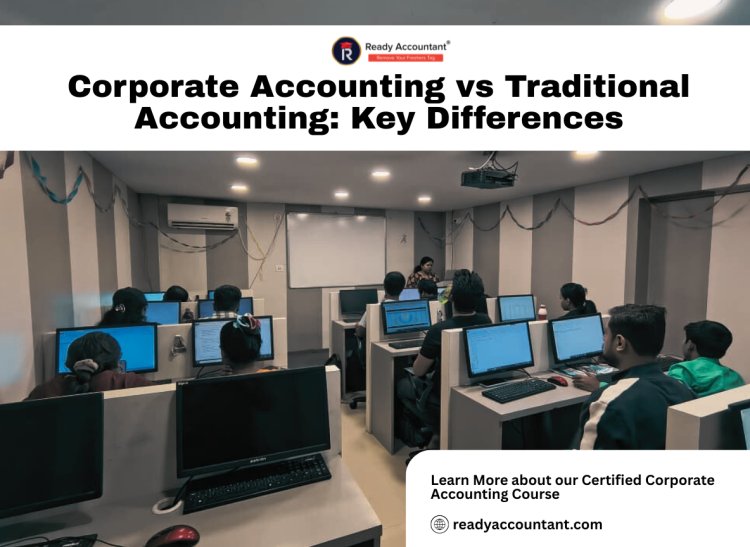
Corporate Accounting vs Traditional Accounting: Key Differences
Corporate Accounting vs Traditional Accounting: Key Differences highlights how accounting practices are evolving in today’s digital business environment. Traditional accounting focuses on manual record keeping, paper-based documentation, and historical financial analysis, which can be time-consuming and prone to errors. In contrast, modern or corporate accounting uses advanced technologies, automation, cloud systems, and ERP tools like SAP FICO to manage financial operations efficiently. It enables real-time reporting, improved accuracy, better compliance with Income Tax & GST, and data-driven decision making.
In today’s fast-changing financial environment, accounting practices are experiencing major changes. Businesses are moving away from old bookkeeping methods to more advanced and technology-driven systems.
It is important for students, professionals, and business owners to understand Corporate Accounting vs Traditional Accounting: Key Differences to stay relevant in today’s financial world.
Traditional accounting is the conventional method of recording, maintaining, and analyzing financial transactions using manual processes or basic accounting systems. It has been widely used for many years by small businesses and individual accountants.
This approach mainly focuses on recording financial data such as sales, purchases, expenses, and income in physical ledgers or simple accounting software.
Definition of Traditional Accounting
The Definition of Traditional Accounting can be explained as the manual or semi-manual process of maintaining financial records, preparing financial statements, and ensuring compliance with accounting principles without heavy reliance on advanced technology or automation.
Traditional accounting systems mainly depend on accountants to perform tasks like:
-
Bookkeeping
-
Journal entries
-
Ledger posting
-
Financial reporting
Most of these tasks are handled manually, which can increase workload and the possibility of errors.
Key Features of Traditional Accounting
Below are the Key Features of Traditional Accounting:
1. Manual Record Keeping
Most financial transactions are recorded manually in journals or ledgers.
2. Paper-Based Documentation
Invoices, bills, and other financial records are often stored in physical documents and files.
3. Limited Automation
Traditional systems rely heavily on human effort instead of automated tools.
4. Time-Consuming Processes
Preparing financial statements and reports can take a significant amount of time.
5. Basic Financial Analysis
Traditional accounting mainly focuses on historical financial data rather than predictive insights.
Although these methods are still used by many small businesses, they may struggle to keep up with the demands of modern financial management.
What is Modern Accounting?
What is Modern Accounting?
Modern accounting, also known as corporate accounting or digital accounting, uses advanced technology and integrated financial systems to manage financial operations efficiently.
It goes far beyond simple bookkeeping and includes:
-
Financial analysis
-
Compliance management
-
Automation of accounting tasks
-
Strategic financial decision-making
Modern accounting systems often use tools such as:
-
ERP systems
-
Cloud accounting platforms
-
Enterprise financial software
Examples include professional systems like Certified Corporate Accounting programs, SAP FICO (Finance & Controlling), and advanced Taxation modules covering Income Tax & GST.
These tools help businesses process large volumes of financial data quickly, accurately, and efficiently.
Key Features of Modern Accounting
Here are the Key Features of Modern Accounting:
1. Automation of Financial Processes
Modern systems automate tasks such as invoicing, payroll processing, and tax calculations.
2. Cloud-Based Accounting Systems
Financial data can be accessed securely from anywhere, enabling better collaboration.
3. Integration with ERP Systems
Platforms like SAP FICO (Finance & Controlling) help integrate financial data with other departments.
4. Real-Time Financial Reporting
Businesses can monitor their financial health instantly.
5. Advanced Compliance Management
Modern systems help ensure compliance with tax regulations such as Income Tax & GST.
6. Data-Driven Decision Making
Companies can analyze financial trends and predict future financial outcomes.
These features make modern accounting a powerful tool for organizations looking to improve efficiency, transparency, and strategic planning.
Differences Between Traditional and Modern Accounting
Understanding the Differences Between Traditional and Modern Accounting helps highlight how accounting has evolved.
| Aspect | Traditional Accounting | Modern Accounting |
|---|---|---|
| Process | Mostly manual | Highly automated |
| Data Management | Paper-based records | Digital & cloud-based |
| Speed | Slower processing | Faster & real-time |
| Accuracy | Higher chance of errors | Reduced errors through automation |
| Reporting | Periodic reports | Real-time financial insights |
| Integration | Limited integration | Integrated with ERP systems |
| Decision Making | Historical analysis | Predictive & strategic analysis |
These differences clearly explain why businesses are rapidly adopting modern accounting systems.
Benefits of Modern Accounting Over Traditional Accounting
There are several Benefits of Modern Accounting Over Traditional Accounting, especially for growing businesses.
1. Increased Efficiency
Automation reduces manual workload and speeds up accounting operations.
2. Improved Accuracy
Digital systems significantly reduce calculation errors and data inconsistencies.
3. Real-Time Financial Visibility
Business owners can monitor income, expenses, and profitability instantly.
4. Better Compliance Management
Modern systems simplify compliance with tax regulations such as Income Tax & GST.
5. Scalability for Business Growth
Modern accounting tools can easily manage large transaction volumes as businesses expand.
6. Strategic Financial Planning
Businesses can analyze financial data to make smarter and more strategic decisions.
These advantages make modern accounting essential for companies operating in competitive markets.
Challenges of Traditional Accounting in Today’s World
Despite its importance in the past, there are several Challenges of Traditional Accounting in Today’s World.
1. Higher Risk of Human Error
Manual data entry increases the possibility of mistakes and miscalculations.
2. Limited Data Accessibility
Physical records make it difficult to retrieve financial information quickly.
3. Inefficient for Large Businesses
Traditional methods cannot efficiently manage complex financial operations.
4. Slow Reporting Processes
Preparing financial reports manually can be time-consuming.
5. Difficulty in Compliance Management
Manual systems make it harder to stay compliant with modern tax regulations and financial laws.
Because of these challenges, businesses that rely solely on traditional accounting often face operational inefficiencies.
Why Businesses are Transitioning to Modern Accounting
Many organizations are asking Why Businesses are Transitioning to Modern Accounting.
The main reasons include the growing need for:
-
Speed
-
Accuracy
-
Financial transparency
-
Regulatory compliance
-
Strategic insights
Modern technologies such as ERP systems, SAP FICO (Finance & Controlling), Certified Corporate Accounting programs, and digital taxation systems for Income Tax & GST help businesses streamline financial operations and improve productivity.
Additionally, modern accounting systems allow businesses to integrate finance with other departments like:
-
Sales
-
Inventory
-
Human Resources
This creates a unified and efficient business management system.
The transition to modern accounting not only improves operational efficiency but also helps businesses remain competitive in a rapidly digitalizing global economy.
Conclusion
Understanding Corporate Accounting vs Traditional Accounting: Key Differences is essential for anyone involved in finance, accounting, or business management.
While traditional accounting laid the foundation for financial record-keeping, modern accounting systems provide powerful tools that improve efficiency, accuracy, compliance, and decision-making.
With rapid digital transformation, businesses are increasingly adopting modern accounting technologies such as SAP FICO (Finance & Controlling) and professional training programs like Certified Corporate Accounting, which also include Taxation modules covering Income Tax & GST.
What's Your Reaction?